
The new feature of domain redirection automatically redirects visitors to their corresponding domains according to their IP address. For example, let's say if your Canadian domain is .com/ca and your Chinese domain is .com/zh and visitors from China accesses .com/ca, they will be automatically redirected to .com/zh. After enabling this feature, your store will use temporary redirects between different URLs. Those temporary redirections allow search engines to approach all your URLs and compile indexes for them, making them searchable for your visitors. This feature helps enhance the shopping experience of customers by displaying content relevant to their language, currency, and region, which do a lot good in building familiarity and trust. It also improves international brand image and increases professionalism.
Setting domain redirection for your store
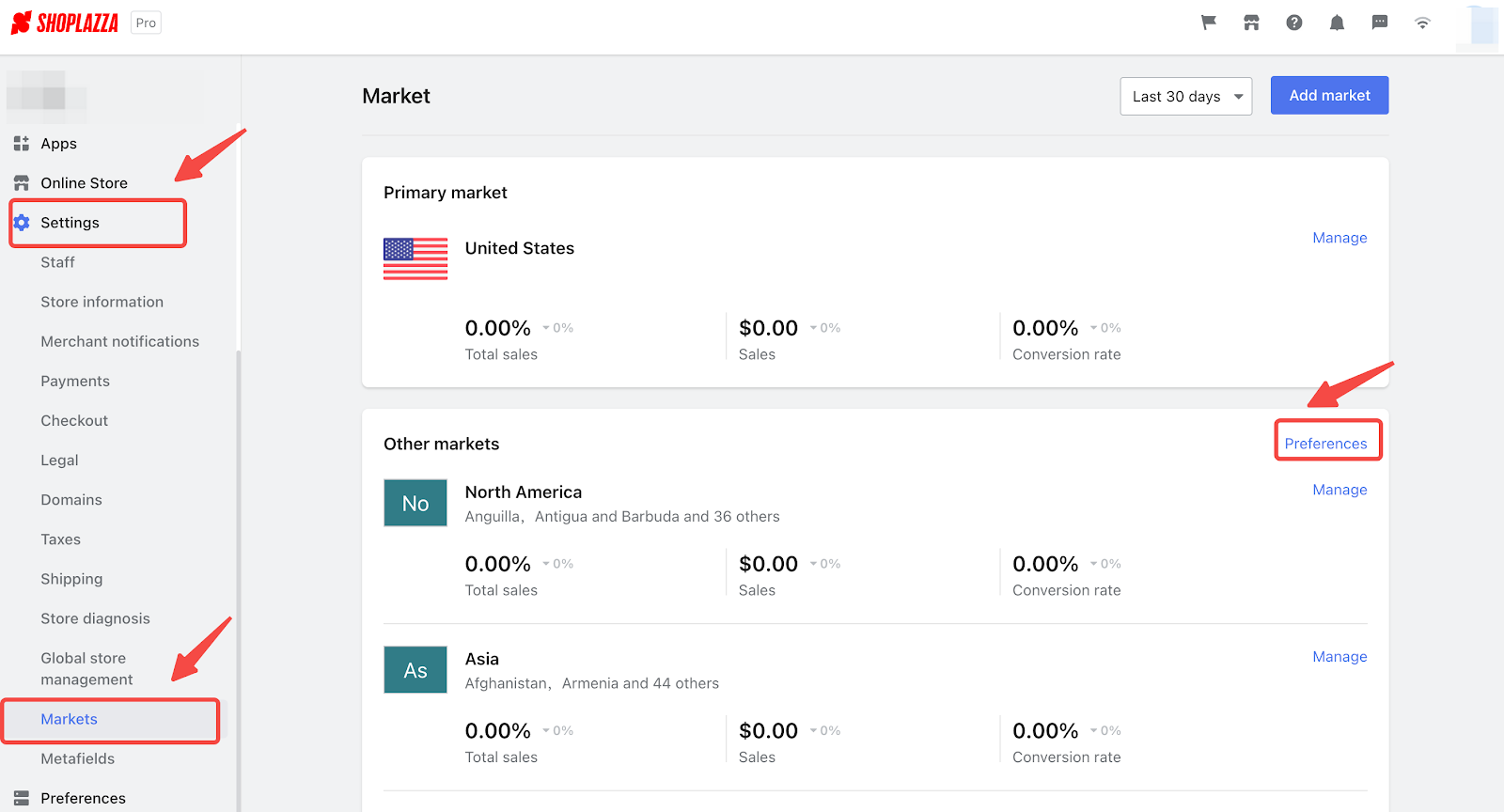
1. Access the domain redirection setting page in Shoplazza Admin > Settings > Markets and click Preferences.
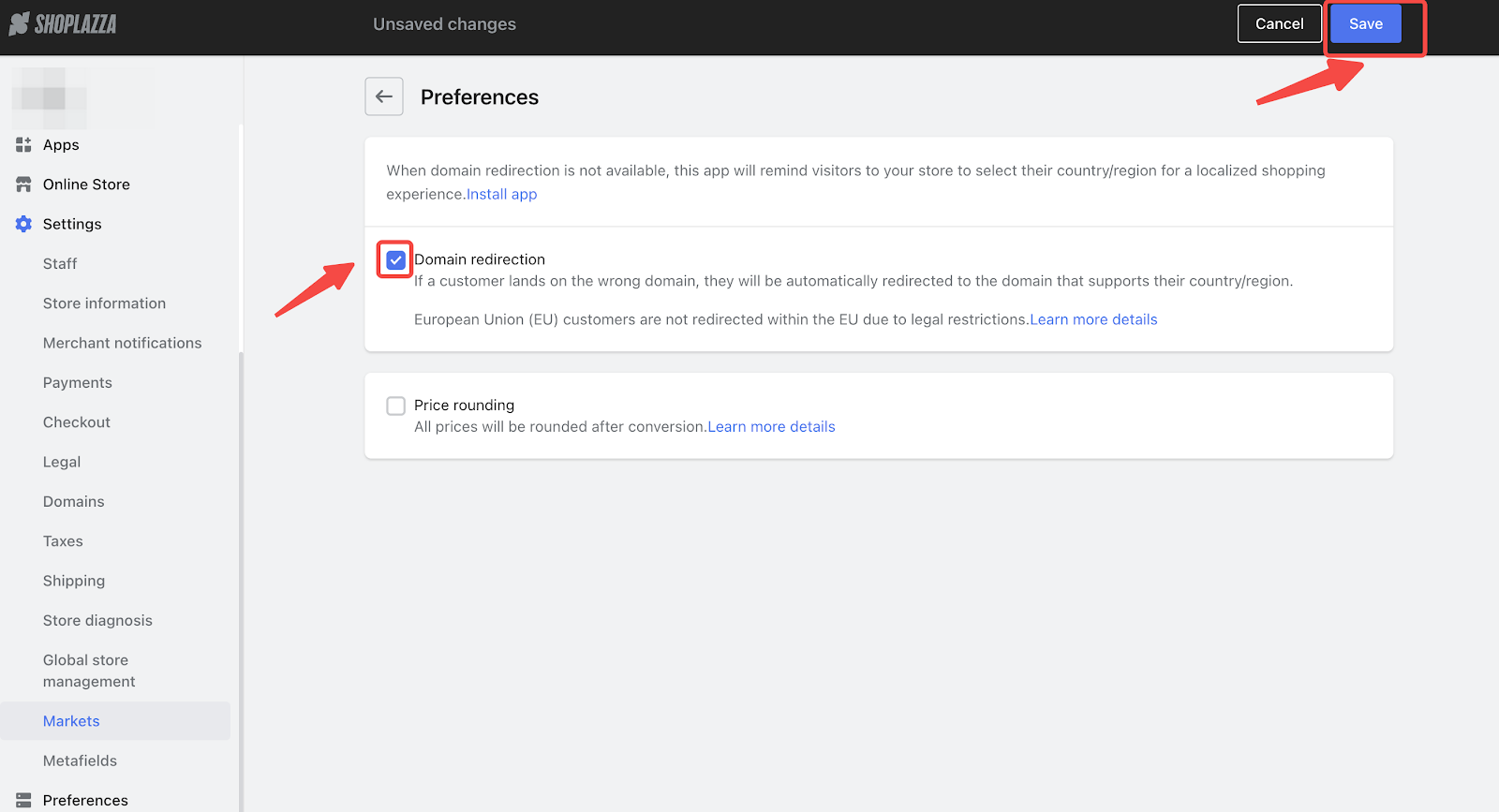
2. Tick the Domain redirection checkbox and click on the Save button on top.
By using domain redirection, your visitors will automatically be redirected to different domains or subfolders based on their IP locations. Domain redirection helps make your store more approachable, user-friendly, diversified and professional.
EU and UK Region Redirect and Market Identification Logic
1. Core Logic Overview
To comply with EU and UK regulatory requirements, the system will not use IP addresses for visitor redirection. Instead, the visitor’s market environment will be determined using the following priority order:
- Cookie Preferences (User Preference Priority): If a visitor has previously accessed a specific market, the system will prioritize reading the cookie and continue displaying that selected market.
- URL Path: If no cookie record exists, the system will strictly determine the market based on the URL path entered by the visitor (e.g. /gb, /fr, or no suffix for the default/main market).
2. Access Logic Examples
Assume your store is configured as follows:
- Main Market: www.example.com (Currency: USD)
- UK Market: www.example.com/gb (Currency: GBP)
- France Market: www.example.com/fr (Currency: EUR)
Scenario A: First-time visit (no cookies)
When a consumer from the United Kingdom (UK) visits your store for the first time:
| Consumer-entered URL | Final Market | Market Currency | Logic Determination |
| www.example.com | Main Market | USD |
No cookie and no suffix; remains in the main market (no IP-based forced redirect is triggered). |
| www.example.com/gb |
UK Market
|
GBP |
No cookie, but URL contains /gb; enters the UK market. |
| www.example.com/fr |
France Market
|
EUR |
No cookie, but the URL contains “/fr”, indicating entry into the French market. |
Scenario B: Returning visit (existing cookies)
If the consumer previously visited the France site and has a cookie stored:
| Consumer-entered URL | Final Market | Market Currency | Logic Determination |
| www.example.com |
France Market
|
EUR |
Cookie priority. The system recognizes the user’s historical preference as France and automatically displays the France site. |
| www.example.com/gb |
France Market
|
GBP |
Cookie priority. Although the user’s IP is in the UK, IP-based redirection is not allowed due to regulatory requirements. Since a France cookie already exists, the system prioritizes the France market. |
| www.example.com/fr | France Market | EUR |
Cookie priority. The system recognizes the user’s historical preference as France and automatically displays the France site. |


Comments
Please sign in to leave a comment.