
Issuing is a virtual corporate credit card (VCC) management feature offered by Shoplazza Accounts. It lets you apply for, manage, and use Mastercard virtual credit cards online, covering global online payment scenarios such as advertising, SaaS/AI subscriptions, cloud services, and corporate procurement. One card per scenario keeps budgets clear, spending under control, and reconciliation effortless.
What is a virtual credit card
A virtual credit card (VCC) is an online payment card that requires no physical card. Each virtual card has its own card number, expiration date, and CVV, and can be used for online payments just like a physical credit card, while providing more flexible budget management and fund control.
Compared with using a single bank card for all online payments, virtual credit cards let you manage funds for different businesses independently, helping merchants control budgets, track spending, and reduce the financial risk of card information leakage. Issuing supports two issuing regions—Hong Kong cards (HK) and US cards (US)—and the available use cases vary by issuing region:
🇭🇰 Hong Kong cards (HK)—support both Regular cards and Shared cards, covering the following use cases:
- Advertising: Facebook, Google Ads, TikTok Ads, YouTube, Telegram
- Subscriptions: ChatGPT, Cursor, Namecheap, Humble Bundle, Webshare, and more
- Cloud services: AWS, Cloudflare, DigitalOcean, OVHcloud
- E-commerce: Amazon, AliExpress, SHEIN, DHgate, Shopify
- Logistics: FedEx, UPS, USPS, T-Mobile, and more
- Travel: Agoda, Ctrip, Meituan, airlines, hotels
- Others: PayPal, Alipay, WeChat, Google, and more
🇺🇸 US cards (US)—support both Regular cards and Shared cards, mainly used for the following use cases:
- AI tools (US cards only): Claude, ChatGPT (OpenAI), Gemini Advanced, Cursor, Midjourney, Perplexity
- Advertising: Facebook, Google Ads, TikTok Ads, YouTube, Telegram
Tips
Differences between issuing regions and use cases:
- AI tools is a use case exclusive to US cards; Hong Kong cards do not offer a standalone AI use case (some AI platforms such as ChatGPT and Cursor fall under the "Subscriptions" use case for Hong Kong cards).
- Hong Kong cards cover more use cases (Advertising / Subscriptions / Cloud services / E-commerce / Logistics / Travel / Others); US cards focus on AI and Advertising.
- The exact available use cases and platforms are subject to what is actually displayed on the card application page for the selected issuing region.
Card types
Issuing offers two card types—Regular cards and Shared cards—each corresponding to a different fund management model:
- Regular card: A per-card independent balance model. Each card is applied for and topped up individually, and spending is deducted directly from that card's balance. Ideal for "one card per business" independent budget management, such as a single ad account or a single vendor payment.
- Shared card: A funding pool (Issuing account) model. Multiple shared cards draw from the same funding pool, and spending is automatically deducted from the pool with no need to top up each card individually; you fund the Issuing account (minimum 100 USD), and auto fund in is supported. Ideal for unified fund management scenarios such as multiple ad accounts, multi-team collaboration, and corporate procurement.
Fees and card issuance rules
Fee overview
| Fee type | Charging standard |
| Card issuance fee | The first 100 cards per account are free (Regular cards and Shared cards counted together); a fee applies beyond that. |
| Top-up fee | Free. |
| Transaction fee (≥ 50 USD) | Free. |
| Transaction fee (< 50 USD) | A fixed fee charged by the card network and deducted from the card balance. |
| Card balance refund fee (Regular card) | Refund amount × fee rate. |
| Transfer-out fee (Shared card) | Charged when transferring out from the Issuing account to the primary account; transfer-out amount × fee rate. |
| Dispute fee | Chargeback: for a single transaction > 600 USD, 30 USD + 2% of the transaction amount; for ≤ 600 USD, a fixed 30 USD. Pre-arbitration handling fee: 40 USD + 2% of the transaction amount. Additional fees charged by the card network are borne by the customer. |
Card issuance rules
| Rule item | Description |
| Maximum cards per batch issuance | Up to 10 cards. |
| Free card quota | The first 100 cards per account are free (including cards in all statuses; Regular cards and Shared cards counted together). |
| Free quota recovery | Not restored: cancelling or closing a card does not return the free quota. |
| Initial top-up at card issuance | Once the free cards are used up, a top-up is required at the time of issuance, with a minimum of 100 USD; zero-balance cards cannot be issued. |
| US cards / AI use cases | Support both Regular and Shared card types. |
Issuing page overview
Go to Finances > Shoplazza Accounts > Issuing. The page contains the following tabs: Shared cards, Regular cards, Transactions, Cardholders, Rebate. The top of the Regular cards page displays overview information such as the available Issuing balance, remaining free cards, and transaction amount trends.
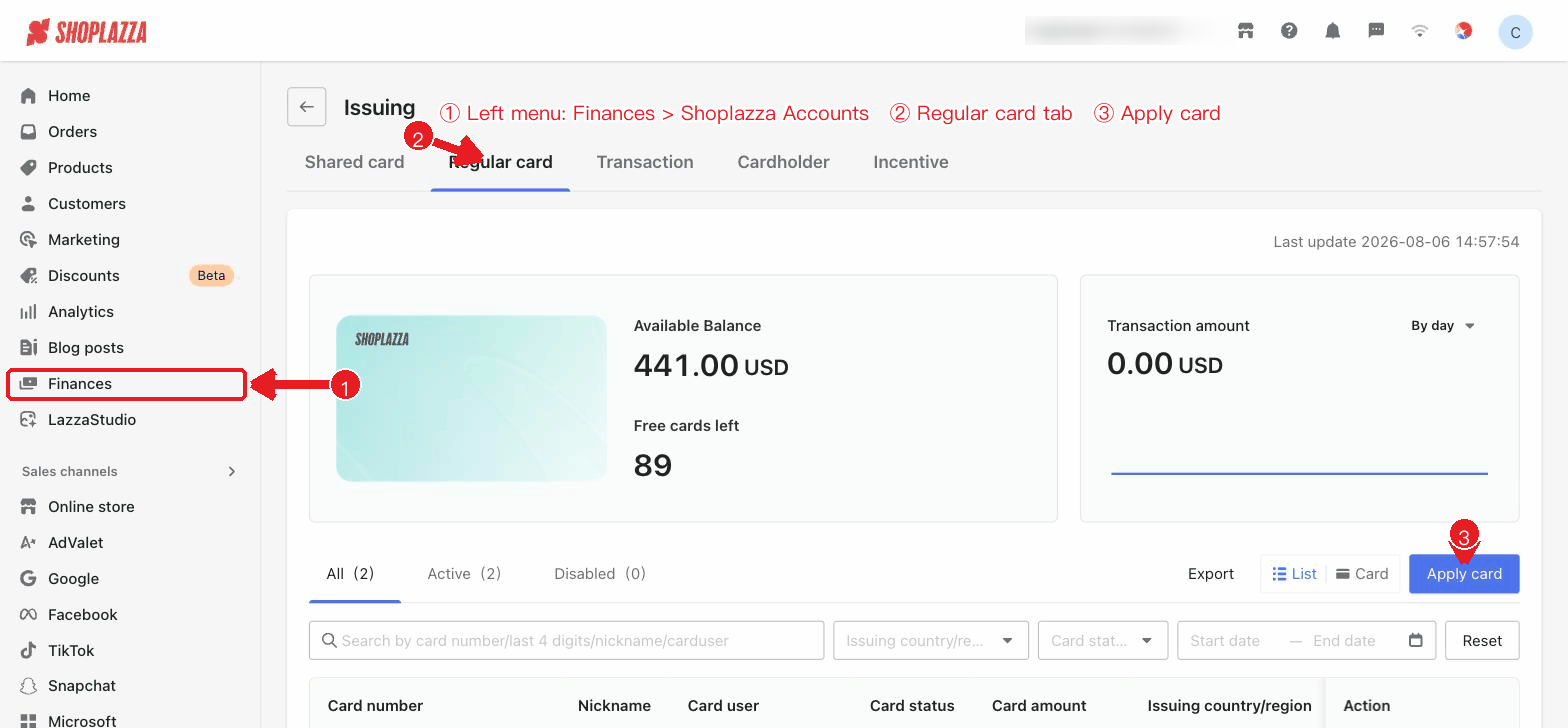
Feature specifications
| Item | Description |
| Card network | Mastercard |
| Card type | Regular card, Shared card |
| Issuing region | HK Hong Kong cards (Regular cards, Shared cards); US US cards (Regular cards, Shared cards) |
| Supported currency | USD |
| Card validity | 3 years |
| Issuance method | Online application |
| Usage | Global online payments |
Note
- The issuing region only indicates where the card is issued and is unrelated to the company's registration location or the location of the entity; the issuing regions supported may differ by card type, so refer to what is displayed on the application page.
- All virtual cards use USD as the settlement currency and can be used for global online payment scenarios that support the corresponding card network.


Comments
Please sign in to leave a comment.