
For cross-border e-commerce merchants going global, controlling the payment dispute rate has always been a major challenge. An excessively high dispute rate not only directly causes revenue loss for merchants, but may also result in serious consequences such as warnings or penalties from payment channels or even card networks. To help merchants control their dispute rate, maintain the stability of their acquiring channel, preserve customer satisfaction, and protect their brand reputation, we have introduced a solution for reducing dispute rates called SDR (Smart Dispute Resolution): we have currently integrated the Verifi RDR and Ethoca products. Verifi RDR only covers disputes on Visa cards, while Ethoca mainly targets Mastercard and also covers disputes on some other card types.
Note
This feature currently only supports Shoplazza Payments. Support for other third-party payment channels is being planned — stay tuned!
Feature Advantages
- Control the dispute rate and reduce the risk of penalties
Enabling the SDR feature can help merchants effectively control their dispute rate, thereby avoiding the possibility of being fined by card networks.
- Automated handling saves time and reduces resource waste
Once rules are set, disputes or alerts can be handled automatically, helping merchants reduce the resource drain involved in gathering dispute evidence and communicating rebuttals, so merchants can focus their energy and resources on more valuable business areas.
- Improve customer experience
The time from when a dispute is filed to when it is resolved is typically at least one month or more, and such a long wait often causes significant customer dissatisfaction. SDR enables customers to resolve disputes within one week, effectively improving customer experience and helping merchants better maintain customer relationships going forward.
- One-click activation, no integration required
Shoplazza Payments has already completed integration with the product. Merchants can activate the feature and configure rules with one click in the backend, with no need to invest resources in installation or integration.
Verifi RDR
What is it?
Verifi RDR (Rapid Dispute Resolution) is an end-to-end dispute resolution product from Visa that helps merchants automate dispute handling, improve customer relationships, and reduce dispute rates. While this product cannot completely eliminate disputes, it can improve the efficiency of dispute handling through automation, thereby reducing unnecessary resource waste.
Although Verifi RDR only supports disputes on Visa cards, it supports the majority of issuing banks.
How RDR Works
Whenever a customer (legitimately or fraudulently) questions a transaction on their bank account or is charged fraudulently, a dispute occurs. Once a dispute arises, the merchant is required to respond, and the issuing bank will make a ruling based on the merchant's response and the dispute materials provided by the customer. If the ruling goes against the merchant, the merchant will be responsible for the dispute processing fee as well as the loss of the corresponding order amount.
At the same time, card networks impose regulatory requirements on merchants' dispute rate data. If the dispute rate is too high, the merchant may be placed into the Visa Acquirer Monitoring Program (VAMP). If the dispute rate cannot be brought under control within the timeframe required by the monitoring program, the merchant is likely to face severe financial penalties from the card network.
Furthermore, in the process of responding to disputes, merchants often need specialized knowledge to submit evidence and communicate rebuttals; when there are too many disputes, the entire process can place a considerable burden on and disrupt the merchant's daily operations.
To address the issues above, RDR allows merchants to customize rules to automatically issue fast refunds for disputes that meet the specified conditions. Disputes handled this way will not be counted into the card network's dispute monitoring program, helping merchants resolve the problem of an excessively high dispute rate while also relieving the pressure of the dispute response process. In addition, customers no longer need to go through the lengthy dispute handling process to get their money back, helping merchants improve customer experience and maintain customer relationships.
RDR rules support merchant customization. Merchants can configure rules according to their own business characteristics and risk preferences:
- Set a refund threshold: orders with an amount below the set threshold will be refunded automatically (for example: set disputes under $100 to be processed automatically);
- Refund all: after receiving an RDR dispute, a refund will be automatically issued regardless of the amount.
- Multi-currency service activation is also supported, allowing merchants to customize which currencies should be processed.
Ethoca
What is it?
Ethoca Alerts is a flagship product from Ethoca, a company under Mastercard. It mainly covers disputes on Mastercard, with signals sourced from thousands of issuing banks in the Ethoca network.
As the name suggests, if a cardholder contacts their issuing bank attempting to file a dispute, Ethoca will notify the merchant in advance — before the dispute is formally filed — giving the merchant an opportunity to contact the customer directly. The merchant can then prevent the dispute from occurring through effective communication with the customer or by issuing an immediate refund.
In addition, based on historical experience, while effective communication with the customer can help merchants avoid some potential disputes, directly refunding the customer (regardless of whether the purchased goods are returned) is usually the more effective and recommended approach for avoiding disputes.
How Ethoca Works
When a customer, for some reason (perhaps dissatisfaction with the product, or not having received the goods), denies a transaction on their bank account or intends to file a chargeback, they contact their issuing bank directly to dispute the charge. When the issuing bank is a member of the Ethoca network, it will immediately pass this information on to Ethoca, and Ethoca will send an alert to the merchant using the product, notifying them to take action immediately.
After receiving the alert, the merchant may agree to the dispute and immediately refund the customer, contact the customer to communicate, or take no action (which will usually turn into an actual dispute). In most cases, the merchant has 72 hours to decide how to proceed. We recommend that merchants complete processing within 24 hours of receiving the notification, to ensure sufficient time to handle any unexpected situations that may arise.
Setup Path
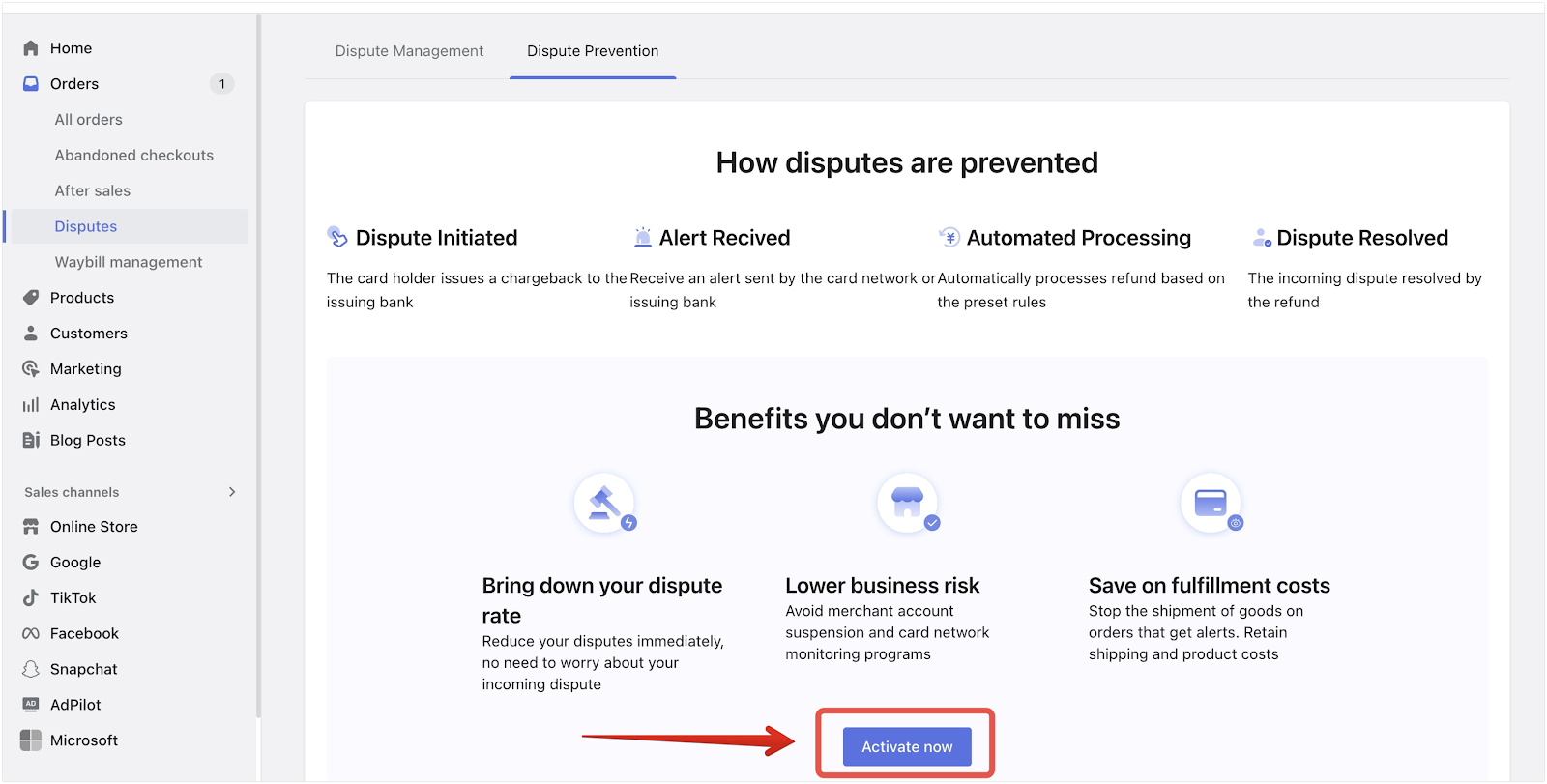
1. Log in to your Shoplazza Admin, and go to Orders > Dispute Orders > Dispute Prevention. If no service has been activated yet, you will see an introductory page about the service; click Enable Service.
2. In the pop-up window, select the service and set the processing rules:
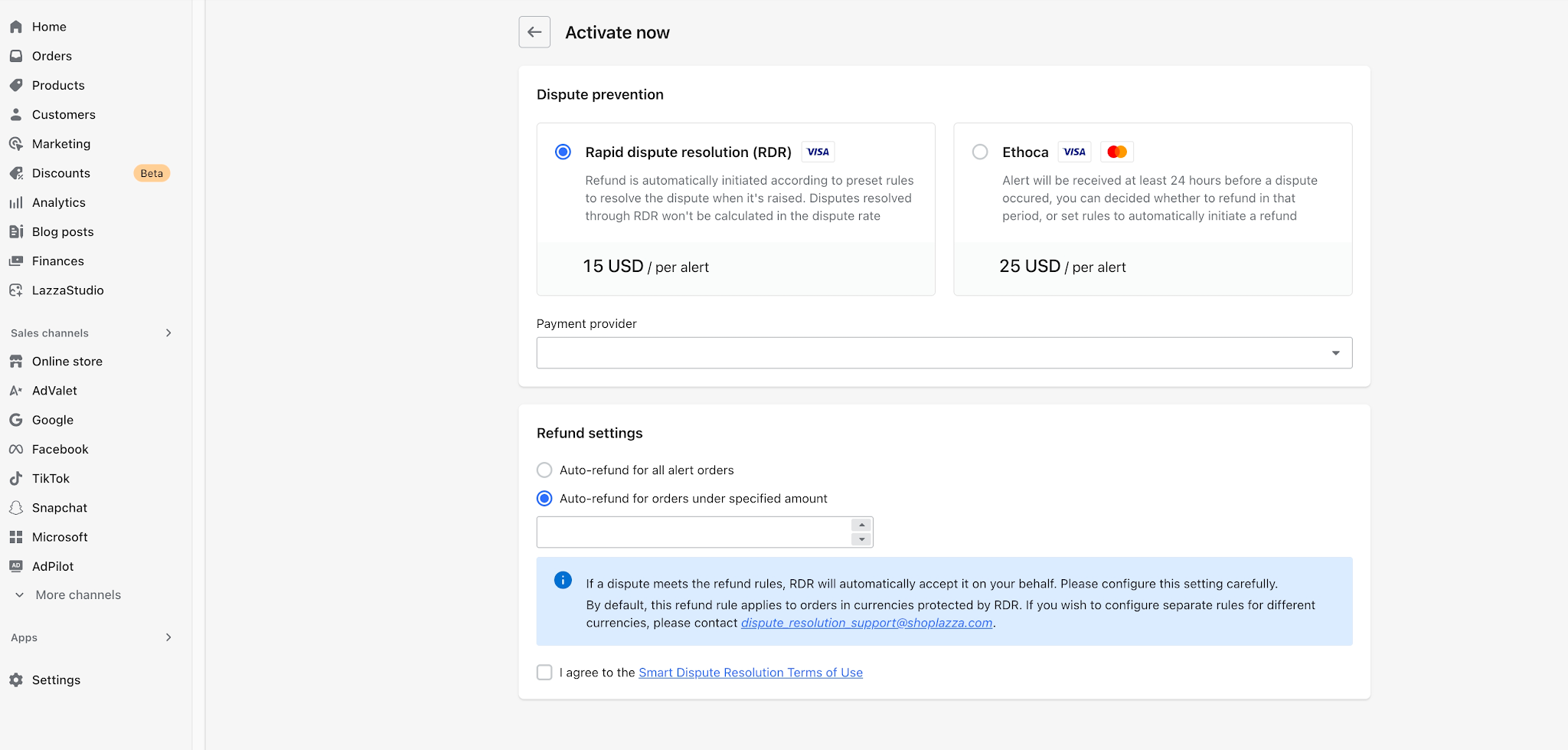
- When selecting RDR, set a refund threshold or choose to refund all;
- When selecting Ethoca, set the refund amount strategy (required), shipping status (optional), and alert type (optional) separately for Visa / Mastercard according to the "Ethoca Rule Settings" section below.
Tips
- You can set the corresponding rule based on your average order value. If you are unsure how to set an appropriate threshold, you can send an email to dispute_resolution_support@shoplazza.com for consultation.
- After the rules are set, orders that meet the refund rules will be refunded automatically.
- Among Ethoca's three rules, Rule 1 (refund amount strategy) is required, while Rule 2 and Rule 3 are optional and can be added on top of it.
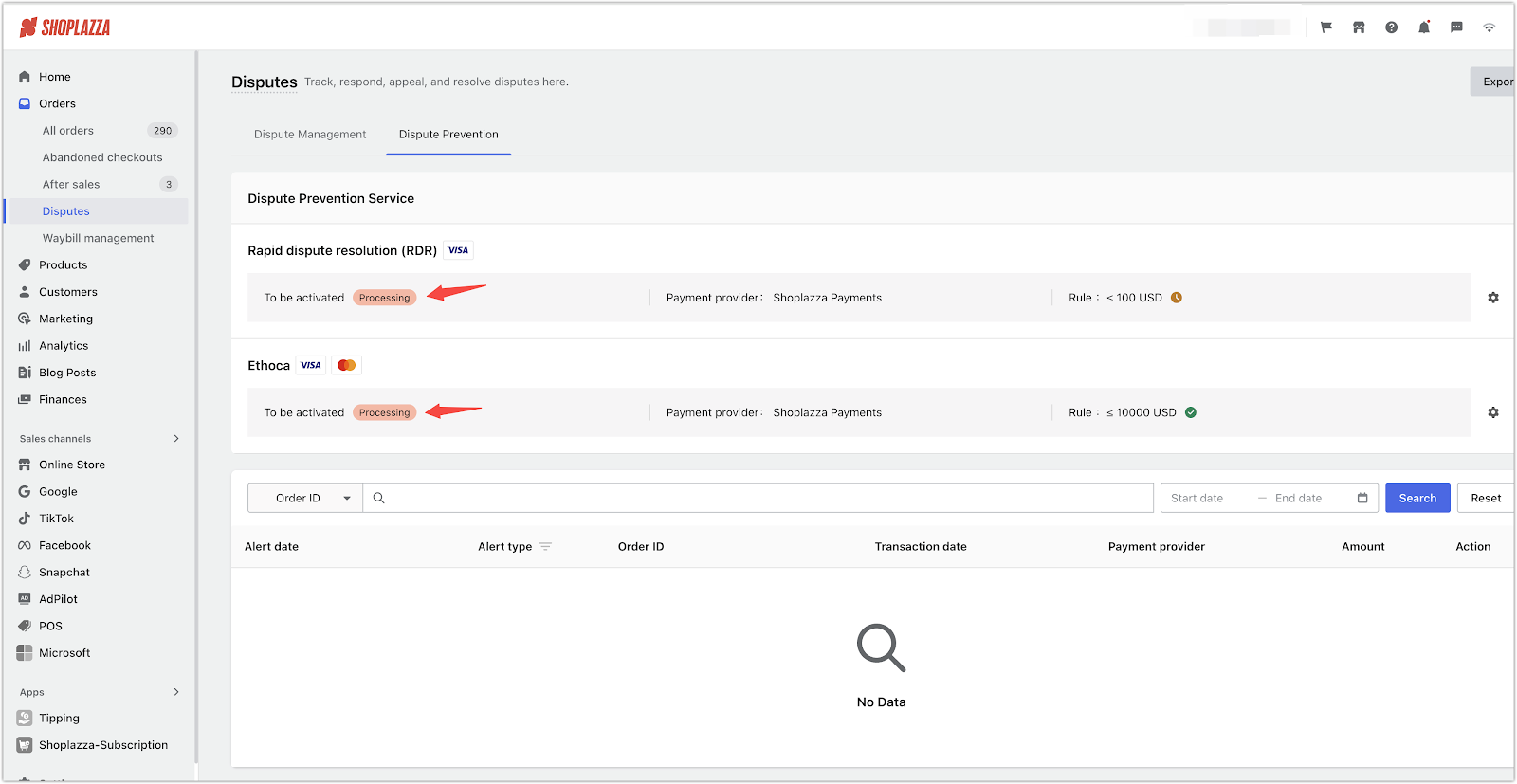
3. After clicking Confirm, you will see the selected service in Pending Activation status. Generally speaking, activating the RDR service takes 3–4 weeks, while activating Ethoca takes 2 business days.
4. Ethoca Rule Settings
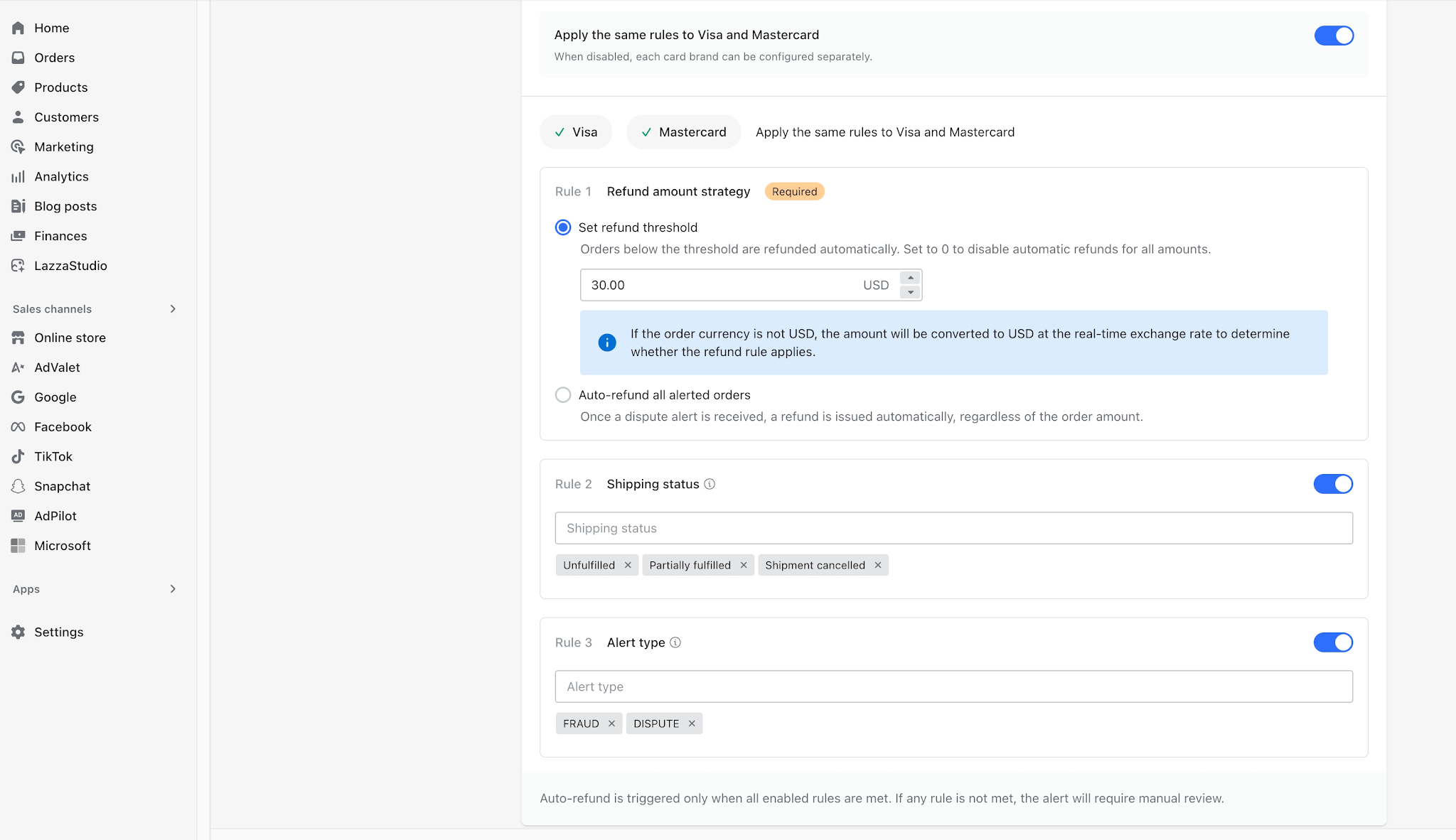
- Visa / Mastercard rule sync toggle
- The setup pop-up has "Use the same rules for Visa / Mastercard" enabled by default;
- While enabled, changing the configuration for either brand will automatically sync to the other brand;
- Once sync is turned off, Visa and Mastercard can be configured independently with their own refund rules, meeting the need for differentiated management based on the risk preferences of different card networks.
- Description of the three configurable rules
- Rule 1 · Refund Amount Strategy (must be enabled, choose one of two)
- Set a refund threshold: orders with an amount below the set threshold will be refunded automatically; entering 0 means no amount under this brand will be refunded automatically. If the alerted order's amount is in a currency other than USD, it will be converted to USD using the real-time exchange rate before determining whether it meets the threshold.
- Automatically refund all alerted orders: after receiving an Ethoca alert, a refund will be automatically issued regardless of the amount.
- Rule 2 · Shipping Status (optional, supports multi-select dropdown)
- Once this rule is enabled and the corresponding shipping status (such as "Awaiting Shipment") is selected, Shoplazza will check the current shipping status of the order when an Ethoca alert is received, and this rule is only considered satisfied if the status matches one of the selected options.
- The available statuses are consistent with the order module: Awaiting Shipment, Partially Shipped, Fully Shipped, Partially Fulfilled, Fully Fulfilled, None, Shipment Cancelled, Return in Progress, Returned, No Shipping Required, Partially Returned.
- Rule 1 · Refund Amount Strategy (must be enabled, choose one of two)
Special note: Shipping status data comes from the order module. To make effective use of this rule, please ensure that the order's shipping status is updated promptly.
- Rule 3 · Alert Type (optional, supports multi-select dropdown)
- FRAUD: The cardholder denies the transaction (the card was used without authorization), and the issuing bank determines it to be a fraudulent transaction. If this rule is enabled, it is strongly recommended that FRAUD be selected; otherwise, if the case escalates into a formal dispute, the rebuttal will almost certainly fail, and additional dispute fees will be incurred.
- DISPUTE: The cardholder placed the order themselves, but has filed a dispute with the issuing bank (possible reasons include forgetting the charge, dissatisfaction with the product, a purchase made by a family member, etc.). This type of alert leaves room for evidence: if the transaction amount is relatively high and there is proof of delivery, the merchant may consider not refunding and preparing a rebuttal; if the transaction amount is relatively low or the dispute rate is already high, refunding is usually more cost-effective.
Ethoca's official recommendation: issuing a direct refund upon receiving an alert is usually the optimal solution. If you decide not to refund and instead wait to submit a rebuttal, please be sure to proactively contact the customer within 24 hours of receiving the notification to understand the reason for the dispute, because once it escalates into a formal dispute, additional dispute fees will be incurred, and the outcome of the rebuttal cannot be guaranteed.
The three rules have an "AND" relationship: the amount, shipping status, and alert type must all be satisfied simultaneously to trigger an automatic refund; any rule that is not enabled does not participate in the evaluation.
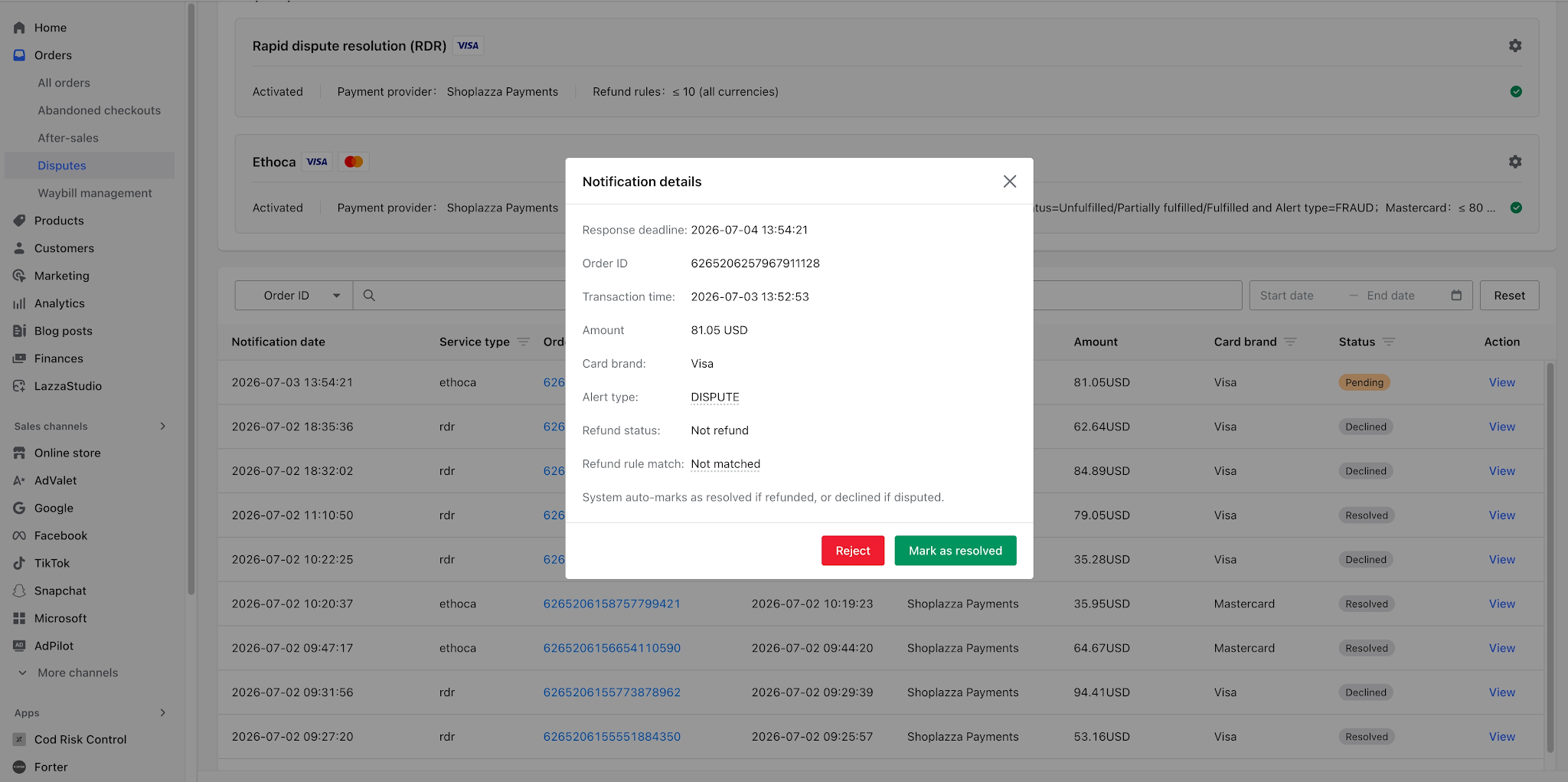
Dispute Notification Status Description
- Newly added notifications are all in Pending status;
- For orders that match the rules and are refunded automatically, the status will change to Resolved;
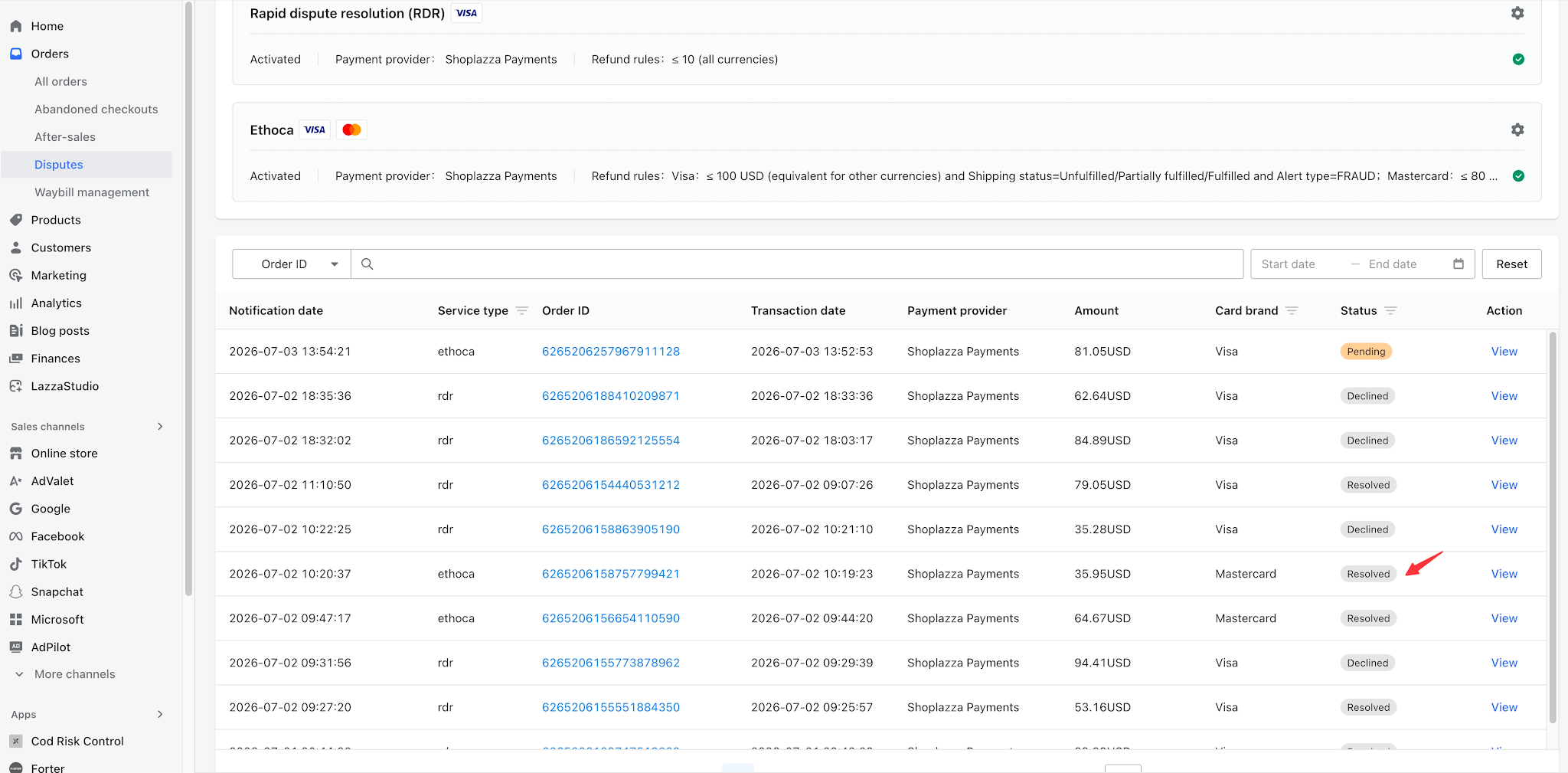
- Click the Action button to view the notification details; for orders that do not match the rules and remain in Pending status, the merchant can manually process the refund to change the status to Resolved.
Case Studies
- Before enabling RDR, Merchant A's Visa card dispute rate was as high as 2.5%, with over 100 disputed orders, placing them into the VDMP program. After enabling RDR, the dispute rate was successfully reduced by 1%, bringing the number of disputed orders below 100 and meeting the VDMP standard, thereby avoiding penalties from the card network.
- Before enabling Ethoca, Merchant B's dispute rate was as high as 7.5%; after enabling it, the dispute rate was brought under control to 4.5%.
- If the order associated with an Ethoca alert already had a partial refund before the alert was received, the system will not automatically mark the alert as "Resolved," but will instead mark it as "Pending," and will remind you via an in-site message to handle it within 24 hours: you may choose to contact the customer to resolve the issue through communication, or directly issue a full refund for the remaining order amount, to avoid the case escalating into a full-order dispute later and causing greater losses.
Tips
If you have any questions about using this feature, you can send an email to dispute_resolution_support@shoplazza.com for consultation.


Comments
Please sign in to leave a comment.